Powered By Blogger

Friday, May 11, 2012

The Three Cornered Country Loaf or Don't Blame the New Camera

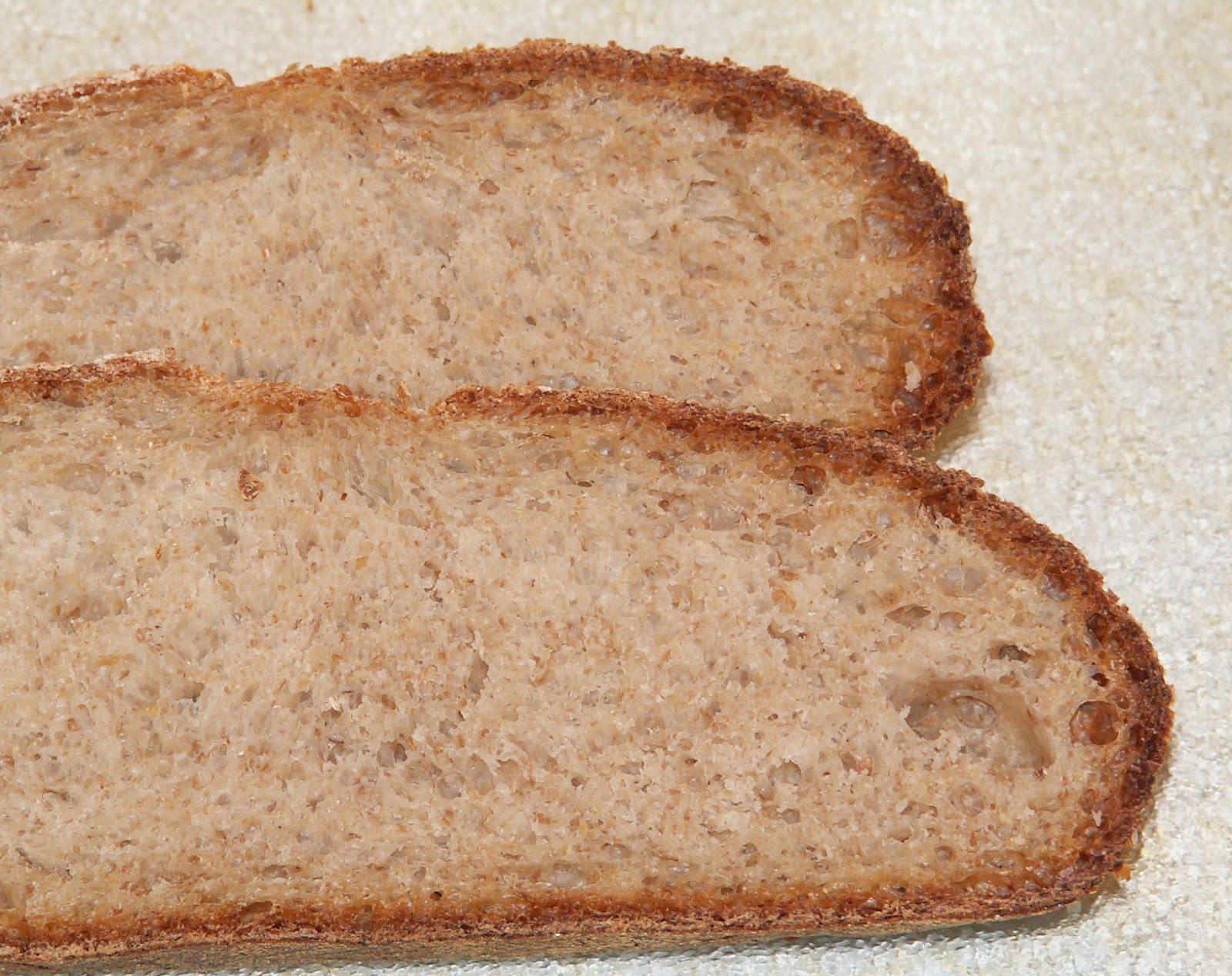
I won't blame my new camera for this odd looking Country Loaf. A new Fujifilm F505 was delivered by the USPS last week and I still haven't quite got the fine details down yet.
There a plenitude of specialized programs that I'm sure I'll use once just to see how they work and after the pictures are deleted I'll go back to trying to get the best picture with the least work. The flash is somewhat odd but that may be a function of the light metering program built into the camera. But, with the help of my Picasa 3 program, I might get the pictures I want to post here.

The bread is in the style of Thom Leonard's French Country Loaf  with the addition of some wheat germ. The misshapen appearance is probably due to my use of a less than dangerously sharp paring knife to slash. Some of the dough got tugged around during the last slashes but I kind of like the odd shape. Chances are I won't be able to replicate it again if I try.
Like many of my recent loaves, the starter was large and of medium hydration, around 70%. Most of flours are really thirsty these days so I'm learning the necessity of adjusting the dough.
Starter:
190g of 70% hydration

Soaker:
35g wheat germ
100g stone ground whole wheat flour
135g water


Main Dough:
265g bread flour
25g whole rye flour
150g water at 85F
8g kosher salt
all of starter
all of soaker

This loaf won't be set out to feed the chatterbox squirrel that berates us every time the bird feeder is empty. He has no complaints these days, after feeding well on the seeds dropped by our feathered friends, he can no longer climb the PVC pipe that we use for hanging the feeder outside my window.   


Comments, humor, and questions are welcome.
Posted by Picasa

Wednesday, May 09, 2012

A Practice Pain Italien

   While I'm disappointed that the peonies in the yard are making a hasty exit, the garden is yielding my first pickings of leaf lettuce. There's been about 5" of rain over the last eight days and the lettuce responded with vigorous growth. There were no pretensions of precision when I planted my lettuce. I put a tablespoon of cane sugar in a bowl and put in some lettuce seeds. They were from the last two years so I had an excuse for my heavy hand. Then I took said bowl and went out to the garden to spread the mix down the three foot long row. The sugar made it easy to see where I had sewn seed. I moved the dirt back on top of the row, watered in the seeds and waited for the bountiful harvest. It took awhile but it has come around. The first planting is Parris Island Romaine and the second is Green Ice. It won't last long into the heat of summer but the first pickings from the garden are always the sweetest, regardless of the crop.

This afternoon's bread is my first, but very casual, attempt at a Pain Italien loaf, something that the French boulangers near the Italian border pride themselves on knowing how to do well.
Once again, I stepped over the edge of the cliff and decided to use my own ideas rather than a fixed recipe from someones book. It's not perfect but not bad either. First of all, because the recipes I saw called for using AP flour, I thought a poolish or biga was in order.

I started with a 78% hydration preferment build. After mixing it up, I left it on the kitchen counter at room temp, 71F, for a few hours before putting it into the fridge overnight.
I'm not crazy about all white flour bread so I measured out some wheat germ and stone ground whole wheat flour to add some color and texture to the crumb.Then I added some non-fat dry milk and olive oil to help keep the crumb tender.
The result was two baguette looking loaves, one 245g and the other 275g after baking. Without adequate steaming, the crust wasn't up to Parisian standards for baguette color. I suspect that 50 minutes of proofing was inadequate for an open crumb. I could have done much worse.  
The crumb has turned out to be soft and on the sweet side. With a few changes, I think that I could get closer to the ideal. Practice makes perfect so whenever I plan to serve a pasta dish, I'll have a good reason to revisit this recipe.


Poolish:

103g AP flour
80g water at 85F
                                                                  1/8 tsp, maybe a gram or so of active dry yeast.
Hydrate the dry yeast for 10 minutes in the water then mix in flour. Cover and leave at room temperature, 70-74F, for 2-3 hours and then refrigerate over night, taking out to the counter at least two hours before mixing dough.

Main Dough:
225g AP flour
20g stone ground whole wheat flour
5g wheat germ
165g water at 85F
5g non-fat dry milk
8g olive oil (1/2 Tbs)
7g kosher salt
1/2 tsp active dry yeast

I baked the loaves in a perforated two loaf pan. The slashing patterns showed up in a somewhat exaggerated manner but I don't mind. This was the first time I got a recognizable baguette type loaf without major league agony. There's work to be done but the result is encouraging.

The last loaf was Friday's work. It too was under proofed which means that I have to get over my worries about that. As the average temperatures rise, the challenge to find the sweet spot with the proofing dough will be more amusing than before. Thank goodness I can eat the less than perfect loaves and consume the evidence.

Comments, humor, and questions are welcome.


Posted by Picasa

Monday, April 30, 2012

Pain Complet au Son, imperfect

This bread is on a par with my title, imperfect, but with lots of good intentions and not that bad for a first attempt.

The translation of the title is approximately "whole wheat bread with bran". Originally, I was going to do a "pain au son" or "bread with bran" from Clayton's "Breads of France". Then I saw a bread called "Campognolo" from Field's "Italian Baker" which was quite similar. As one good acquaintance reminded me, there are only so many types of flour and only so many combinations possible so I decided to launch off into my own ideas just because I can. So I did.


 This was the first time I worked with bran as a component. While researching recipes on Google, I ran across several French recipes where there was prominent mention of the importance of bran in assisting the "transit time" through the digestive track. Clayton's BoF was the only resource that mentioned the first time user would be surprised by the amount of water that the bran is capable of absorbing. He was right on target with his advice. Throw out your preconceptions about hydration when using bran and be ready to adjust your water higher during the mixing.


 I started out with the not too novel idea of presoaking the bran. I put 100g of water in a small container and by the time I had added 37g of bran, the container was full. After stirring down the bran and water, all the water had been absorbed and the bran was only damp, not wet. Adding to the difficulty in estimating hydration was the fact that 25% of my flour was white whole wheat.

Soaker:
100g water
37g BRM wheat bran

Soak bran for AT LEAST one hour before mixing dough. It probably wouldn't hurt to go as many as four hours.

Starter:
140g of white flour starter at 66% hydration

Main Dough:
300g bread flour
100g white whole wheat flour
9g kosher salt
190g water at 85F, plus additional water to adjust during mix. I used two Tbs or approximately 30g.
All of soaker
All of starter

During the initial mix, I included a wrinkle in my usual procedures. I added the soaker, the water, starter, and 100g of the WWW flour to my mixing bowl and then used the whisk attachment to disperse the starter. I learned about this step from the Breadcetera blog site. After that, I followed my usual procedures for the loaf. While I was baking using the "magic bowl" method, I made the mistake of not quite clearing the loaf as I removed the bowl. That probably didn't help a bit.

This can be a very good bread, despite the dubious authenticity of its title.  It can't truly be an authentic "Pain au Son" because French law dictates a 25% bran content in the loaf. Something like that should be effective at speeding up any one's "transit time".

There's still a little bit of the bran bitterness in the taste that should be familiar to folks who use hard red winter wheat for their whole wheat component. Soaking the bran for one hour didn't hurt and four hours should be better. Experimentation with the hydration of the soaker is in order for the truly obsessive. My first thoughts are that 300% will be my starting point in my next experiment with bran. Hydration for the rest of the loaf will also be a little high, around 70%, since bran is still new for me. Besides having nutritional value, bran adds an interesting flavor. Learning how and when to use bran will be  more difficult than using wheat germ but it will be just as rewarding.

The yard has responded well to a 2.25" soaking rain fall on Sunday. Everything seems to be a little greener and the plants in the garden look a little taller. I doubt the rain had anything to do with it, but there are some new birds and some long absent showing up at the feeders. A red headed woodpecker was a guest this morning as was a rose breasted grosbeak. There was a bird that looked similar in size to a goldfinch but had a bright blue body with black wings. That may have been a migratory bird since it doesn't show up in my "Birds of Kansas" book. I also saw a dark grey and black bird that, judging by its behavior, may be another type of woodpecker that's not native to this area. The birds are feeding quite heavily and spilling almost as much onto the ground. The squirrel that had been climbing up the support poles to the feeders seems to be more than satisfied with all the seeds it can find on the ground. Hummingbirds and orioles should be here shortly so it's time to find some poles and feeders to hang around the yard.

My new camera should be here on Saturday but I'm thinking I should have ordered some binoculars as well. There's a lot to be seen outside the window by my keyboard.

Comments, humor, and questions are welcome.


Wednesday, April 25, 2012

Another Big Starter Loaf and More Peonies!

 While not really momentous, I did get something accomplished today, found some new ingredients for bread making, and narrowed my choices down for a new camera. I want to post better brag shots.

As of today, the largest part of the garden is now in. I haven't turned over the area I intend to use for cucumbers since there's still some cool weather predicted in the long range forecast.
I also put down some wheat straw as a mulch to help retain moisture and keep the weeds down. It also does a double duty of adding organic matter to the soil as it breaks down throughout the year..
 
The inventory of plants added to the already established garlic, snow peas, and lettuce is as follows: four tomato plants, one sweet pepper, three chile peppers, three Genovese basil, one Salem rosemary, volunteer dill and cilantro plants.

The peonies are really at work in the yard. There still another four or five varieties that haven't bloomed as of yet. I admit that I lost track of the number and their names a long time ago. I just plant them, take care of them, and enjoy them when they finally come around.
I suspect that the reason for them being so early is that they are sensitive to soil warmth rather than length of day. In a usual year, the trees would be just starting to fill out so that may explain why the rose scented pink variety is later. The trees in my neighbor's yard are shading the plants. However, by Sunday, there should be enough blooms of that peony that the rose scent will be obvious at least twenty feet from the plants.

Crows have started to hang out the neighborhood lately. They haven't raided the feeders as of yet but the squirrels are going to give them competition if they do. I've taken to putting crushed red peppers in the bird food to discourage their foraging. Some mourning doves have found shade outside my window under the peonies and other mysterious plants. They do a fine job of cleaning up any scattered seeds from the feeder. When something startles them they take off in a flurry of feathers and noise.


This another big starter loaf that happened by lack of attention rather than by design. I meant to save some of the build for seed stock but forgot and adjusted on the fly to get a nice loaf. Once again, I didn't soak my whole wheat flour and I think I'll have to go back to that. My results with a soaker are usually more moist and a little sweeter. For the time involved, it's a no lose step toward a better result.


I added a Tbs of molasses for this loaf and it certainly did no harm. The fermentation was good and vigorous and the crust well colored.

190g of 72% hydration starter using
15g firm starter
40g water
24g whole rye flour
26g 85% AP/15% whole rye starter feed
Second feed:
30g water
50g starter feed

Main Dough:

300g bread flour
100g stone ground whole wheat
27g wheat germ
290g water at 86F
10g kosher salt
15g (or 1 Tbs) molasses
All of starter

While out and about down in Overland Park, KS, I went to a Whole Foods (AKA Whole Paycheck) store to look for some fresh yeast. I talked to the baker on duty at the time who told me that her store didn't carry the product nor did any of the other area stores carry fresh yeast. She said that she had tried to find some for her own baking but couldn't locate any. The stop wasn't a total loss since I found some Bob's Red Mill wheat bran and corn flour for cheaper prices than I can find here in Leavenworth.

I'm not going to mail order fresh yeast given the warm weather we've been having so I'm currently stymied as to where to locate some in the KC, MO area. Topeka, KS and Omaha, NE are my next guesses as to where I might locate some. Time to do some detective work for the search.

Today's out of the ordinary page view was from Chile. If you see an American by the name of Craig Flip, that's my wife's nephew down there. Tell him we said "Hey!"and to email me any local bread recipes he can talk his friends into sharing.


Thursday, April 19, 2012

Pain Menage, a Taloa Experiment, Garden Talk, and Something About Tornadoes

 Our usual latest frost date out here is 15 April. that went out the window this year. Most years on this date, My yard is barely coming to life. The roses will have have a few leaves and the canes will be barely able to take thinning. Not this year, one of my floribunda plantings is already blooming and the David Austin rose is only a few days away.
 Peonies in this area have been blooming about 15 May in most years but the plantings in my yard didn't get the message this year. They're taller than they have been for many years and even the latest blooming variety I have will be ready to go by 1 May. This just happens to be the first bloom for this year. It happened today.

The other perrenials are coming along nicely. I think this one is called "false indigo". Don't mind the change in fonts, the blogger page is having a mind of its own again.


 Yesterday's experiment in baking taloa didn't turn out well. I took some chances with the recipe from Bernard Clayton's "Breads of France", changed quantities, and ended up with less than stellar results.

The first thing I did after deciding to ignore the instructions was to make a poolish rather than treating the bread as a straight dough. Had I been thinking, I should have used a stiff biga since I was concerned about using AP flour instead of bread flour with the corn meal.

Most of the taloa recipes found on the internet through Google use the same ingredients with the exception that the bread is unleavened. The dough is patted flat and cooked in a hot skillet with, and sometimes without, cooking oil. The recipe sounds like the result is a Basque tortilla of sorts. Some recipes included yeast and have a lower, 60-63%, hydration level. I thought that if I cranked up the hydration to around 66%, I'd get a big muffin type bread with a crumb similar to that of an English muffin. That didn't work out at all. I don't think that if I had used bread flour in the 50% flour/ 50% corn meal mix that there would've been more dramatic results. Since I'm not satisfied with the results, I'll go back to the original recipe to see if I over thought this project.

The tornadoes that ripped through Kansas last weekend didn't touch down anywhere near here. Unlike horse shoes and hand grenades, tornadoes really don't matter if they're close. If you can't see them or hear them, 99 times out of a 100 you're OK. It will just be the large hail, high winds, and heavy rains that you have to contend with. Tornadoes are most common in the Spring in Kansas but that doesn't mean they don't happen later in the year. Friends lost the roof to their house, located about ten miles from here as the crow flies, to a tornado on 31 October several years ago.
The name pain menage sounds great, doesn't it? While some women might say that it is a perfect description of what they are afflicted with as soon as their boyfriend or husband has a mid life crisis, according to Bernard Clayton in his BoF book, it means a family loaf. That takes a lot out of the name.

This is my pain menage that came out of the oven lately and is much more successful than the taloa experiment.
It's a simple sourdough bread that didn't require exotic ingredients or arcane techniques. As a bonus, it tastes good as well.

180g 72% hydration starter

Soaker-
60g white whole wheat flour
50g wheat germ
110g water

Main Dough:
All of starter
All of Soaker
25g whole rye flour
265g bread flour
170g water at 85F
10g kosher salt
15g sunflower oil

Finally, my thanks to the folks who stumbled across this blog for the first time from Mexico and India. Then my appreciation to the reader from France. With all the great breads available there, I'm amazed that you'd spend some time with my amateur attempts.

Comments, humor, and questions are welcome.


Thursday, April 12, 2012

Malted Wheat Flake Loaf

This morning's loaf was an idea that I had put off long enough, a loaf with 100g of malted wheat flakes. I was long under the impression that they would be more visible in the crumb than I had achieved. The plain and simple of it is that they don't stand out in the visual aspect of things though they don't subtract from the taste. I think that I'll just use them up and not buy any more. Since I already have a small bag of wheat germ, I'll probably go for some bran and make an attempt at the Genzano loaf which looks somewhat daunting on paper.

This loaf turned out to be rather large and a little bit shaky when I shaped it for the banneton but it turned out fine. It has a moist crumb that's not tough at all and reasonably open for me. Plans are in the works for a better camera for crumb close ups so that I prove I don't brick my loafs very often. Anyways, it's good eating and that counts for more than pedigree.

Malted Wheat Flake Loaf

Starter:
170g of 72% hydration starter

Soaker:
100g white whole wheat flour
100g malted wheat flakes
200g water at room temperature

Main Dough:
300g bread flour
190g water at 85F
10g kosher salt
All of starter
All of soaker   

The hydration was deliberately higher on this loaf because my experience with the malted wheat flakes is that they will need some extra water in the formula. KAF said on the packaging that it wouldn't be needed. If my guess work isn't hopeless, the hydration on this bread ran over 75% and usually I end up with more of a flat bread than a loaf when I get into that territory.  Bake and learn I guess.

The garden is starting off on the right foot this year. Some of the lettuce I put in last week has already sprouted. The forecast calls for rain showers and thunderstorms over the next five days so I'm not optimistic about being able to work the soil until things dry out. There's a great deal of clay in the local soil and despite gardening in the same spot for more than twenty years, I haven't been able to overcome all of it. The rain should make it easier to weed the flower beds on the north side of the lot. They've been ignored for about ten months and I expect to have my work cut out for me once I get going. I do wish I had a lot more cypress mulch to cover up that bed before summer comes in. The discounted bags have all been sold at the garden shops so if I buy any more mulch, it will have to be sorely needed to pay $3 for a 2 cu. ft. bag. Perhaps after hunching over weed ravaged flower beds for a few days my aching back will convince me of the worth of those $3 mulch bags.


Comments, humor, and questions are welcome.

Sunday, April 08, 2012

The Big Starter Loaf and Some Gardening talk

1 January 2012

7 April 2012
I'll open up this fine morning with a little bit of gardening talk. Yes indeed, that's the same cilantro plant. Despite neglect on my part and the vagaries of this year's winter weather, it managed to survive.
 I've finally opened up my wallet and started buying some plants for this year's garden. Two tomato plants, a San Marzano and a Park's Whopper, a Mucho Nacho jalapeno chile, a rosemary starter, and a variety of oregano named "Hot and Spicy". We have a small grow light setup for starting seeds where I can get my basil going soon. 
This weekend's loaf  was an experiment in using a bigger starter for the simple curiosity and fun of doing so. It appears to have worked out reasonably well and certainly tastes like it has.

Somewhere in the blog machinery is a wrinkle that's causing me a great deal of frustration in trying to get the formula in a reasonable order for presentation. Bear with it for a while as I go back to the help pages to find out what I missed.

 Starter:
190g of 66% hydration starter
Main Dough:                                   267g bread flour                               100g  stone ground whole wheat flour    33g whole rye flour                                280g water at 85F+ 15g for correction 10g kosher salt                                    All of starter                                           
 I'm quite pleased with results in that I skipped soaking the whole grain flours and still managed to get a reasonable crumb structure. After using this method, it seems useful to try the liquid levain, or a 125% hydration starter for comparison. 

The juncos have probably migrated north in that I haven't seem them around or beneath our feeding stations. There haven't been any goldfinches for a few days even though they are year round residents of the area. We still have plenty of chickadees, finches, pine siskins, sparrows, the occasional titmice, and my favorites, the woodpeckers.

The latest out of the ordinary, for me that is, page views came from Bulgaria and Japan.

Comments, humor, and questions are welcome.

Tuesday, April 03, 2012

Buckwheat Cupboard Bread

  Whether it was a desperate attempt to justify expenditures or merely indulging my sense of whimsy, I scoured the cupboards and freezers for the most recent loaf. I ran across some malted wheat flakes in a freezer and broke down my resistance or overcame a lack of imagination to include some buckwheat flour.

That basket in the top photo is something that I found at a "World Market" store in KC, MO for all of $4. Had I chosen to wait a while longer, I'm sure I could've gotten a similar looking Easter Basket at half price next Monday. It's my new banneton. 
                                                                                      
   Next up is a candid photo of 160g of 66% hydration starter ready to be put to work. It may not be a handsome sort but it raises the bread.

Buckwheat Cupboard Bread

Starter:
160g at 66% hydration, fed with an 85% AP/ 15% whole rye blend.

Soaker:
100g stoneground whole wheat flour
50g malted wheat flakes
150g water at room temperature

Main Dough:
270g bread flour
30g buckwheat flour
130g water at 85F
9g kosher salt
1 Tbsp honey
All of starter
All of soaker

I don't recall using anything out of the ordinary as far as procedures go with this loaf. I do admit I was simultaneously watching the semi-final game of the Final Four Tournament while I was doing the bulk fermentation so my times between stretch and folds were shall we say, elastic? After all, it was Kansas versus Ohio State and I didn't want to miss the game.
Despite the appearance of the slashes, the bread did turn out reasonably well. The malted wheat flakes do show up in the crumb but I think that 50g isn't enough to show up in the pictures. It's time to increase the quantity to 100g for the next loaf. I also suspect that using the "Magic Bowl" technique would produce a better looking crust.

  There was ample time to work in the garden this afternoon. I turned a section about 3'X6' or about 2 square meters for some snow peas and two varieties of leaf lettuce. My garlic crop got a side dressing of organic fertilizer as well. The forecast calls for rain and occasional thunderstorms over the next few days so my forays into yard will probably be limited to surveying for damage and filling the bird feeders.

Blog stats show that someone located in Saudi Arabia visited this blog in the last few days.


Comments, humor, and questions are welcome.
Posted by Picasa

Friday, March 30, 2012

Trotting out the Turkey Red and some missing "City Limits" loaves

The top picture is my garden plot for this year's expected crop of garlic. I counted some 62 stalks the other day so I lost 6% over the mild winter or due to my haphazard methodology in planting that I covered back in November 2011 or so.   

Below that is a planting of Italian oregano that has overwintered without benefit of mulch. I haven't been getting any really good oregano from the garden for a few years now but the stuff doesn't seem to be malevolent so it can stay until I need the space. If I find a starter for Mexican oregano, that time may be soon.

I donated a couple of pan loaves to the bake sale for the Cushing Hospital Volunteers. In my hurry to get them to the hospital, I forgot to pose them for their beauty shots. I can, however, share a little bit , maybe too much, about them.

Rather than building a starter, I decided to use a biga. At 66% hydration, some would still call it a poolish but I'm not going pro so we are stuck with biga. As part of this lark or experimentation, I went with some Wheat Montana Natural White, which is their all purpose flour instead of the usual bread flour. Because of the biga as my preferment, I managed to get away with using just 3/4 tsp of active dry yeast for the results. After mixing, the dough was easy in handle, fermented and proofed well. The appearance of the end result now leaves me miffed that I didn't get with the program and get those pictures.

City Limits Bread

Biga:
80g AP flour
40g white whole wheat
80g water at 85F
1/4 tsp active dry yeast
Mix well and let sit at room temperature for 11-12 hours.

 Soaker:
60g whole rye flour
60g white whole wheat
120g water at room temperature
Mix well and let sit at room temperature for 4 hours.

Main Dough:
480g Wheat Montana AP
280g water at 85F, used to proof ADY, plus 15g to adjust during mix
14g kosher salt
All of biga
All of soaker

I consider that to have been a really safe formula and the bread probably turned out well. If it didn't, then I guess I can expect an angry email or two because I included my email address on the labels I printed for the loaves.

The loaf included is the latest "turkey red" flour loaf that I've attempted. The turkey red flour (bolted) still retains its flavor. I still don't think the formula is ready for prime time exposure. The loaf isn't bad but I do have to say that I need to learn how to deal with flours that have lower protein levels. The Heartland Mill malted AP  I used seems to be low in protein. There's no information on their old fashioned flour sack packaging and the Heartland Mill website doesn't seem to list that info, at least not any that I could find. I had similar problems with Hudson Cream AP flour which has around 10.5% protein. The Wheat Montana Natural White that I used in the above loaves hits somewhere around 12%, on the high side for AP. The WM acts more like bread flour. As it stands now, my problem doesn't seem to be in the flour but rather a lack of proper technique. French and Italian flours have low protein levels relative to US but their bakers have made magnificent, open crumb loaves for for a long time. Back to the books again because I must have missed something somewhere.

The trees outside are almost all filled out now. A few native red buds and some dogwoods are now blooming. The apple and pear trees have run their course. Our average last frost date is 15 April so if one happens in the next two weeks, there will be some heart broken gardeners.

There haven't been too many birds in the yard for the past few days. The feeders are well stocked but hardly touched. The number of juncos around the feeders has diminished over the past 10 days so they may be on their way north.

It's time to mow the lawn again because I'm going to do something counter intuitive, which is feeding the lawn with fertilizer. As much as I complain about mowing, I also know that the best way to prevent weeds from overrunning the lawn area is to apply fertilizer early enough that the grass  spreads out before the weed seeds germinate. Given that our temperatures have been more like early May than late March, I might be engaging in a futile effort. Oh well, I bought the stuff and if I engage in a little bit of denial about it, no laws will be broken.

This past week's out of the ordinary hits originated in Israel and Malaysia.


Comments, humor, and questions are welcome.


Posted by Picasa

Thursday, March 22, 2012

New Sourdough Pioneer Bread and Bake Sale Practice Pan Loaves

The first loaf up is a another visit to a loaf from last summer. The recipe and ingredients are simple and the bread is satisfying.

Starter:
160g at 75% hydration

Soaker #1:
35g corn meal
42g water at room temperature

Soaker #2:
35g whole rye flour
65g whole wheat flour
100g water at room temperature

Main Dough:
200g bread flour
93g water at 85F
7g kosher salt
2 Tbs sunflower oil
2 Tbs brown sugar
All of starter
All of both soakers

I used Codruta's paper grocery store bag idea for proofing this loaf and that led me a idea for a better device. My idea is to use some pine boards to make a "mold" in a "U" shape, just as long as the bottom of the grocery bag and one of the sides capable of being adjusted for width, depending on the amount of dough used. The idea could be further complicated by using small, rounded molding strips on the bottom of the sideboards. They may not be necessary since towels could be placed under the parchment paper to save expense. Sometimes the improvement that is conceived with the purpose of being an elegant solution to a minuscule problem is just needless expense and complication.

The next two loaves are my practice loaves for next week's bake sale at Cushing Hospital. My mixer is only 4.5L in capacity so I took a chance on how much dough I would need and which pans I could use. It turned out just fine for me. The bread is fine as well.

Starter:
200g at 70% hydration

Soaker:
50g wheat germ
100g whole wheat flour
150g water at room temperature

Main Dough:

450g bread flour
130g water at 85F
11g kosher salt
15g honey
All of starter
All of soaker

I used my small loaf pans that are just right for 600-650g of dough. There was a fine oven spring so the crown was about 1.5" above the rim of the pan at the end of the bake so it all works.

The first day of Spring brought more rain to our yard. The grass is now about 5" long and getting out of hand. At least the unruliness hides some of the bare patches on the lawn. The peonies are taking off, growing about an inch a day it seems. I haven't spotted any ants around the foundation yet but that may be due to their sluggishness in cool weather. The forecast calls for warmer days by the weekend so vigilance is called for. My garlic plantation is doing quite well in this weather and it has surprised me to see that just about all the cloves I planted last Fall have sprouted up.

Needless to say, the weeds weren't fazed at all by the mild winter and are displaying their contempt for my efforts at eradicating them.

Finally, I want to note that the Google statistics for this blog have identified Puerto Rico as another country and not a commonwealth of the US. The statisticians must have gone to school with Rick Santorum. A reader from Poland was counted in the last few days. If you're a relative, stop and post a hello or if you know any of my relatives in Poland, tell them I said Hello!


Comments, humor, and questions are welcome.